





















How to Overseed a Lawn in Pennsylvania
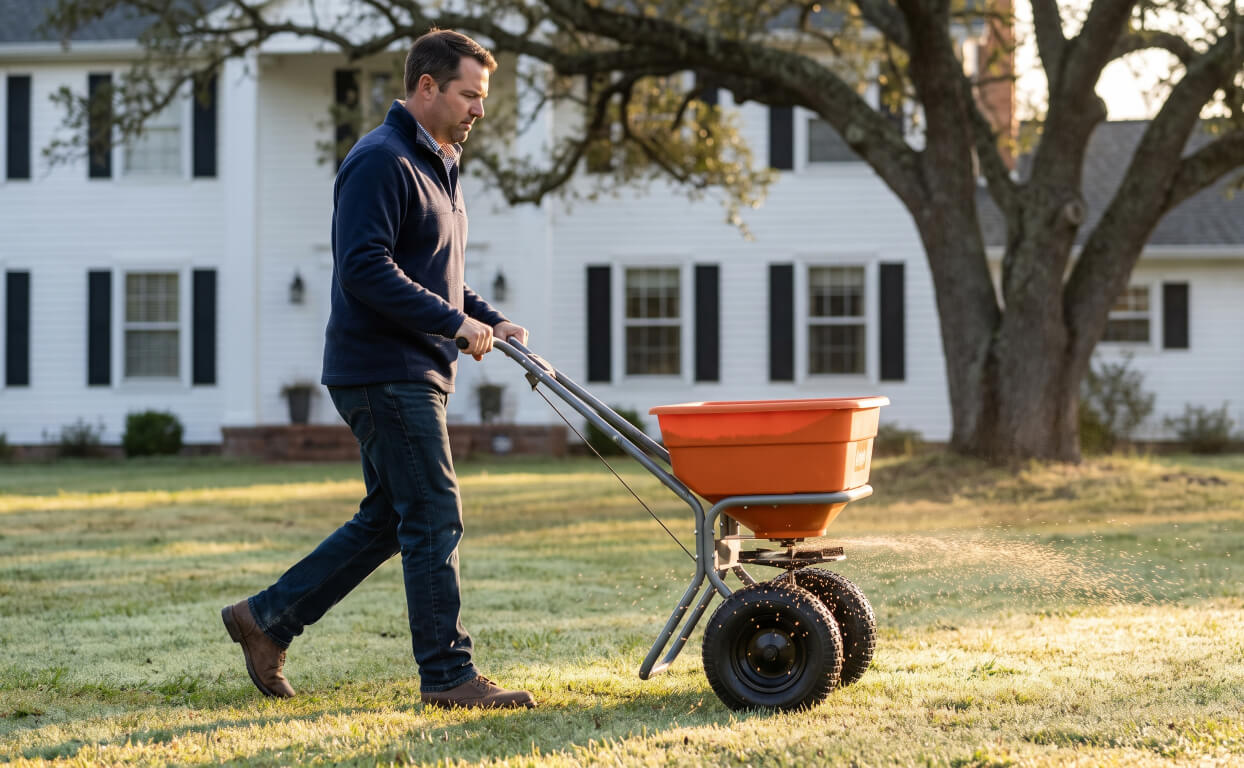
If the lawn looks tired in August, seed it now. Spring is the season that wastes the bag.
Warm soil, cool nights, no crabgrass race. That window is late August through September here.

Wehrung's
August 22, 2026
0
min read
Your lawn looks tired. Thin where the dog turns around. Bare under the maple. Crabgrass in every spot the good grass gave up in July. It looks like this every August, and every August you think about doing something in April.
Do it now. Spring is the wrong season.
Pennsylvania lawns are cool-season grass. Fescue, Kentucky bluegrass, perennial ryegrass, or a mix. They put down roots in warm soil and cool air, which is late August into September, not the week after Easter. Seed in spring and you are paying to grow a crop that July will kill.
Seed in August or wait a year
Drop seed in this window and it germinates into soil that is still warm. Then it roots through a cool, damp autumn with no crabgrass racing it and no July heat on a two-week-old plant. By the first freeze it is established. Next spring it comes back as turf.
Drop the same bag in April and it germinates next to every weed seed already in your dirt. It fights for water in May. The first real heat in June hits a root system a few weeks old. Some of it lives. Most of it does not. By the Fourth of July the bare patches look like you never touched them.
Crabgrass preventer is the trap that makes spring even worse. Pre-emergent herbicide stops seeds from germinating. It cannot tell your bluegrass from the crabgrass. Put it down in March and you have closed the door on seeding for weeks. Fall seeding and a spring pre-emergent never meet. That is the point.
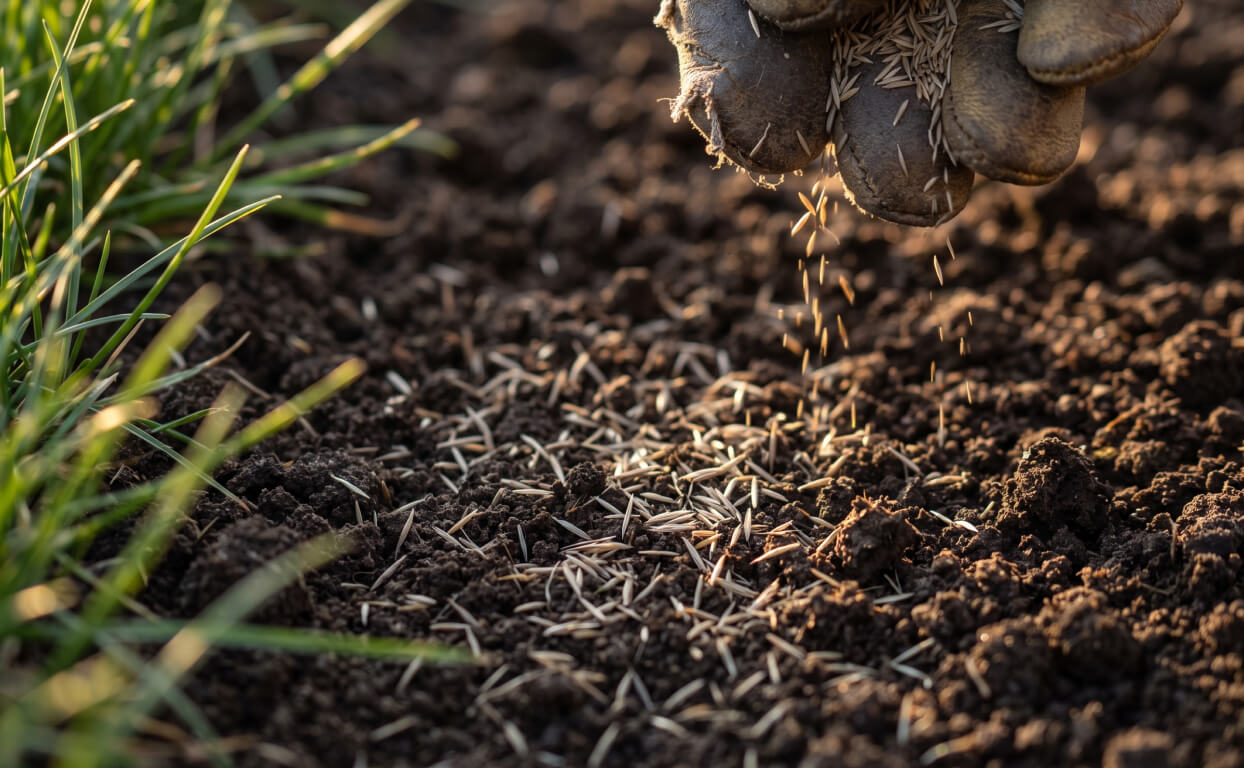
Around here the window runs from roughly the third week of August through the end of September. Early September is the sweet spot most years. Soil still warm, nights starting to cool. Past early October you are betting the seedlings get mature enough to survive the first hard freeze. Sometimes they do. Do not plan a lawn around sometimes.
The three grasses in a Pennsylvania blend are not interchangeable, which is why a cheap bag that is mostly rye looks great at day ten and thin in May. Perennial ryegrass comes up fast, often inside a week. That is the green you see first. Kentucky bluegrass takes two to three weeks and spreads underground, which is what actually fills a bare patch over time. Fine fescues handle shade and poor soil better than either. A decent blend uses all three so the rye buys time while the bluegrass gets going. That is also why a new seeding can look fine at three weeks and better at three months. Do not judge it in October and rip it out.
One Saturday, then three weeks of watering
You need a mower, a rake or a dethatcher, a broadcast spreader, a hose or sprinkler you can actually run every day, and starter fertilizer. If the ground is packed clay, you also need a core aerator. Macungie rents equipment. A Saturday is enough for the prep on a normal yard. The watering is the job that follows, fifteen or twenty minutes, once or twice a day, for two to three weeks. People who skip that last part are the people who say overseeding does not work.
Square footage: length times width of the areas you will actually seed, not the whole lot. Subtract the driveway, the beds, the patio. A 40-by-60 rectangle that is half maple shade is not one bag of sun mix. Walk it. Write the two numbers down. That is what we need at the counter, plus whether you already put down a spring crabgrass preventer.
Dog spots are a different job. Those yellow rings are urine burn and compaction, not a thin lawn. Overseeding them without water and without breaking the crust just draws a faint green halo around a dead circle. Rake them out, flush them if you can, then seed. If the dog still uses the same corner, you will be back next August.
- Mow shorter than usual and bag the clippings. Drop the deck to about two inches for this one cut. You want sunlight on the soil and seed on dirt, not on a mat of grass.
- Rake hard, or dethatch, if you have thatch. Push your fingers through to the soil. More than about half an inch of spongy brown between green grass and dirt, and seed will sit in that layer, sprout, and die when it dries. Pull it out.
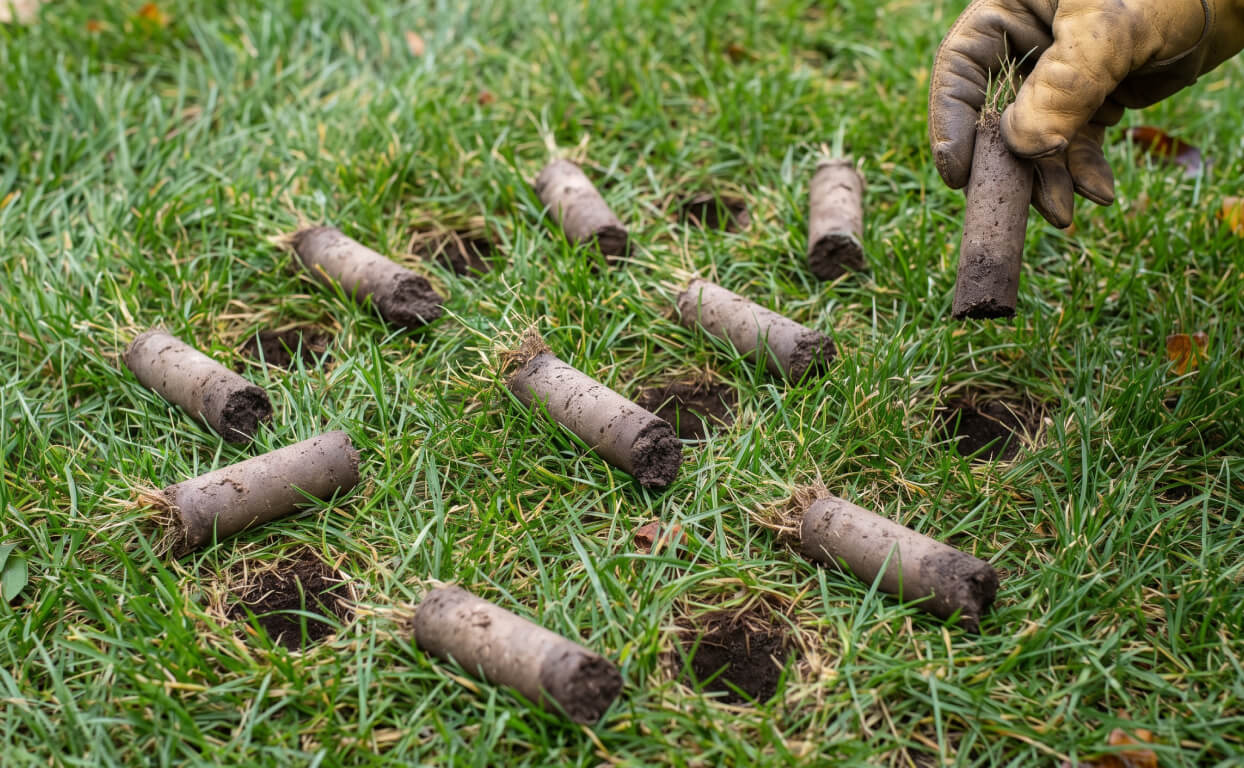
- Core aerate if it is compacted. Foot traffic, clay, anywhere water pools after rain. The machine pulls plugs. Leave them. They break down. Seed that lands in a hole has a chance. Seed that sits on a hardpan does not.
- Spread at the rate on the bag, not by eye. Too light and you wasted the afternoon. Too heavy and the seedlings choke each other. Broadcast spreader on the open areas. Drop spreader along beds and walks. Overseeding rates are lower than new-lawn rates. Read which column you are using.
- Starter fertilizer with the seed. Starter formulas carry phosphorus for roots. Regular lawn fertilizer is often light on it. This is not the week for weed-and-feed.
- Water the top half inch and do not stop. Short sessions, once or twice a day, until it germinates. A deep soak twice a week will not do it. A seed that swells, starts, and then dries out is dead. It does not wait for you.
Keep the light watering up for two to three weeks. Once the new grass is up and you have mowed it once, switch to deeper, less often, to push roots down. Fall rain helps. A dry September here is common enough that you cannot count on it.
First mow at about three inches. Take off no more than a third of the blade. Sharpen the mower first. A dull blade tears young grass out of soft ground. Stay off it until it has taken. Foot traffic on germinating seed is why one strip comes in patchy while the rest looks fine.
When more seed will not help
Failed overseeding is almost never the seed.
It never touched soil. It sat on thatch, or on unraked turf, and washed off or dried out. Seed-to-soil contact is the entire job. Everything before the spreader exists to make that happen.
The watering stopped. A week in, it rained twice, someone assumed nature had it, then eight dry days killed everything mid-germination. Rye can be up while the bluegrass is still a seed. The lawn looks like a partial success and the slow half never made it.
Pre-emergent was already down. Spring application, or a weed-and-feed from May that got forgotten. Check what you put on this year before you buy a bag.
The soil was the problem. Same patch, year after year, is not a seed problem. Compacted clay. Deep shade. Water that sits. pH so far off that grass will not hold. A soil test is cheap and ends an argument you may have been having with yourself for years. Acidic ground is common in this part of Pennsylvania. Lime is often part of the answer, and it is slow. Put lime down because a test said to, not because a bag was on sale, and do not expect it to save a seeding you already threw on sour dirt this weekend. More seed on packed clay is how you buy the same bag next August.
There is a fifth kind of miss that is not a miss. You seeded. It came up. Mid-October it looks thin. That is normal. First-year seedlings are supposed to look modest. The thickening is next spring. That is why you do this in fall instead of the week before a cookout.
When you do buy, read the tag on the bag. Germination rate and weed-seed percentage are printed on it. The cheap bags are cheap for a reason. A high weed-seed number means you are planting three years of problems next to the grass you wanted. If two bags look the same on the shelf, the tag is the difference. It is also the part nobody reads.
Come in with a rough square footage. We will run the seed and the starter, match the blend to the sun and the maple, and tell you which step people in your situation usually skip. A patch that has failed twice is a soil conversation. Bring a photo. Any of the four stores can do this. If you are also building in the same yard this fall, get the deck line chosen before the seed goes down, because you do not want a crew walking your seedlings.
Work out your seed and starter
Bring a rough square footage to any of our four stores and we will sort out how much you need and which blend suits the spot.

.jpg)